

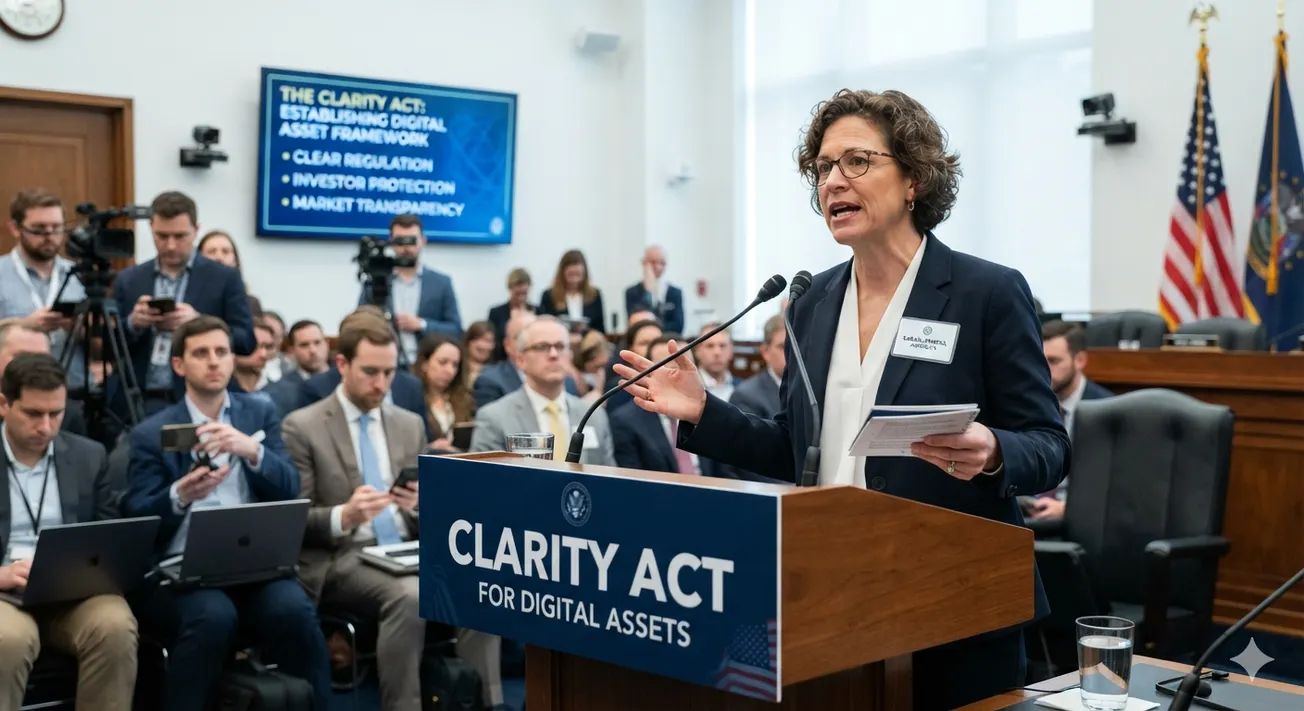
The Digital Asset Market Clarity Act of 2025, commonly known as the CLARITY Act, represents a landmark effort to bring regulatory certainty to the U.S. cryptocurrency industry.
As of mid-2026, the bill remains in legislative limbo despite significant progress, fueling ongoing discussions about America's role in global crypto innovation.
Current Status of the CLARITY Act
The CLARITY Act (H.R. 3633) has advanced through key stages but has not yet become law. It passed the U.S. House of Representatives on July 17, 2025, with strong bipartisan support in a 294-134 vote.
In the Senate, it cleared the Senate Banking Committee on May 14, 2026, via a 15-9 bipartisan vote. However, it has not received a full Senate floor vote or been reconciled with any differing Senate version.
As of July 2026, negotiations continue on unresolved issues, with the bill facing a challenging timeline due to the congressional calendar, summer recess, and upcoming midterms.
Odds of passage in 2026 are estimated around 50-50 or lower by some analysts, though momentum persists through industry advocacy and statements from figures like Treasury Secretary Scott Bessent, urging action.
Steps Remaining Before Becoming Law:
- Senate Floor Vote: The bill must pass the full Senate, potentially requiring amendments and a vote on cloture to overcome any filibuster (typically requiring 60 votes).
- Reconciliation: If the Senate passes a different version, both chambers must reconcile differences in a conference committee or through ping-ponging amendments.
- Final Passage: Both the House and the Senate approve identical text.
- Presidential Signature: The President signs it into law (or it becomes law via pocket approval or veto override).
Even after enactment, federal agencies like the SEC and CFTC would need time to issue implementing rules and guidance, meaning full effects could take months or years.
CLARITY Act as a Key Trump-Era Crypto Regulation and Obstacles to Progress
The CLARITY Act emerged as a cornerstone of pro-crypto policy momentum associated with the Trump administration's second term and broader Republican-led efforts to position the U.S. as a leader in digital assets.
It builds on 2025's "crypto week" in Congress and aligns with the goals of reducing regulatory uncertainty that drove innovation overseas.
Progress has stalled due to several factors. Industry groups withdrew support in early 2026 over revised text, leading to a delayed Senate Banking Committee markup in January.
Key sticking points include stablecoin yield provisions (restrictions on passive interest-like rewards), DeFi regulations, treatment of non-custodial developers, and ethics rules around government officials' crypto holdings.
Bipartisan negotiations continue, but securing all Republican votes and some Democratic support amid concerns over consumer protection, bank deposit flight, and enforcement remains challenging.
Broader political dynamics, including the congressional calendar and competing priorities, have also slowed advancement.
Some observers note that while the bill is important, the crypto industry has grown into a multi-trillion-dollar sector even without comprehensive market-structure legislation, thanks to other regulatory tailwinds.
Importance of the CLARITY Act and Stablecoin Regulations
The CLARITY Act aims to categorize digital assets into digital commodities (primarily CFTC oversight), investment contract assets (SEC), and permitted payment stablecoins (banking regulators).
This division clarifies jurisdictional overlaps between the SEC and CFTC, provides a framework for brokers, dealers, and exchanges, and enhances customer protections in cases like past exchange failures.
For stablecoins, it complements the GENIUS Act (passed and signed in 2025), which established a federal framework for payment stablecoins, clarifying that they are neither securities nor commodities in many contexts.
The CLARITY Act addresses gaps, such as yield/rewards rules and integration with traditional finance, aiming to balance innovation with stability and anti-money laundering measures.
Its importance lies in fostering responsible growth, attracting investment back to the U.S., enabling tokenized assets, and supporting mainstream adoption while cracking down on fraud.
Without it, regulatory ambiguity persists, potentially hindering U.S. competitiveness against jurisdictions like the EU, Singapore, and Japan.
Stablecoin Market: Growth, Usage, and the Recent $10 Billion Slump
Stablecoins have exploded in popularity as the "plumbing" of crypto and traditional finance.
Their total market capitalization surpassed $300 billion in early 2026 (peaking around $311 billion in January), up dramatically from under $50 billion a few years prior.
Annual transaction volumes reached approximately $33 trillion in 2025, rivalling major payment networks, with applications in trading, cross-border remittances, payments, and DeFi.
Major players like USDT and USDC dominate, and issuers hold significant U.S. Treasuries. Growth is driven by regulatory clarity from the GENIUS Act, institutional interest, and integration with platforms like Visa. Projections suggest the market could approach $1 trillion by late 2026 or beyond.
However, the market experienced a notable contraction, shedding roughly $10 billion since its May 2026 peak, with about $7.7 billion of the decline in June alone—the largest monthly drop since 2022.
This represents a modest ~3% pullback, attributed to broader market dynamics rather than systemic issues, and analysts urge calm as underlying adoption trends remain strong.
The CLARITY Act offers a critical opportunity for structured U.S. crypto leadership. While passage in 2026 remains uncertain, its progress signals enduring bipartisan recognition of the need for clear rules.
As stablecoins mature amid volatility like the recent slump, comprehensive legislation could solidify their role in the future of finance. Stakeholders continue watching closely for the next developments in this evolving regulatory landscape.


